
Professionally installed Fixed Wireless Access (FWA) deployments deliver clear advantages over self-install FWA solutions, including:
- Lower churn
- Lower device CAPEX over time through longer device lifespans
- Greater network efficiency
- More stable bandwidth and network connections
These benefits, however, come at the expense of a significant upfront truck roll cost. Depending on the country, the cost of sending a technician to a customer premises can range from only a few dollars to, in some cases, exceeding the cost of the device itself.
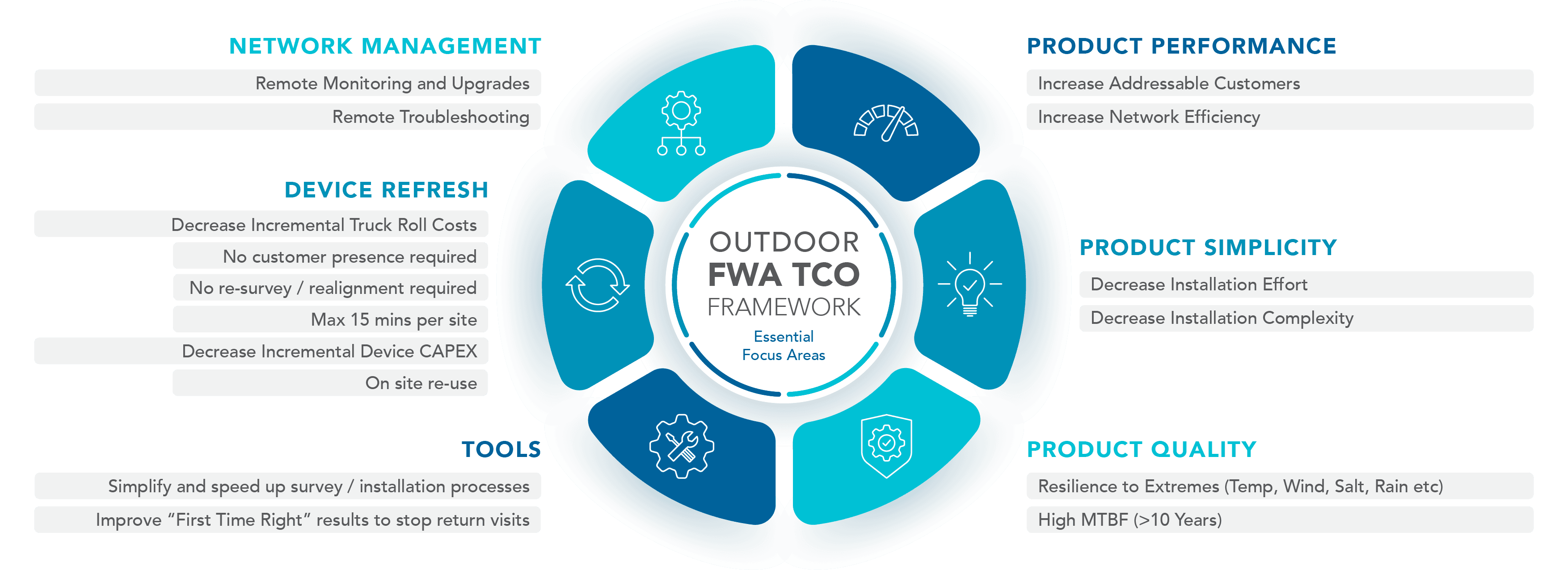
Over the years, vendors such as NetComm have focused on reducing truck roll costs by delivering improvements across multiple areas, including:
Product Simplicity
- Mounting and cabling solutions that are simple and quick to install
- Designs with minimal loose parts, reducing the risk of components being dropped during installation
Tools
- Hardware and software tools that improve the quality, speed, and efficiency of the site survey and installation process
These truck roll cost-reduction and efficiency initiatives, when combined with traditional industry product focus areas such as:
- Product performance
- Product quality
- Network management
form a comprehensive Total Cost of Ownership (TCO) approach to FWA solution development — an approach that has guided NetComm’s product strategy for over 15 years.
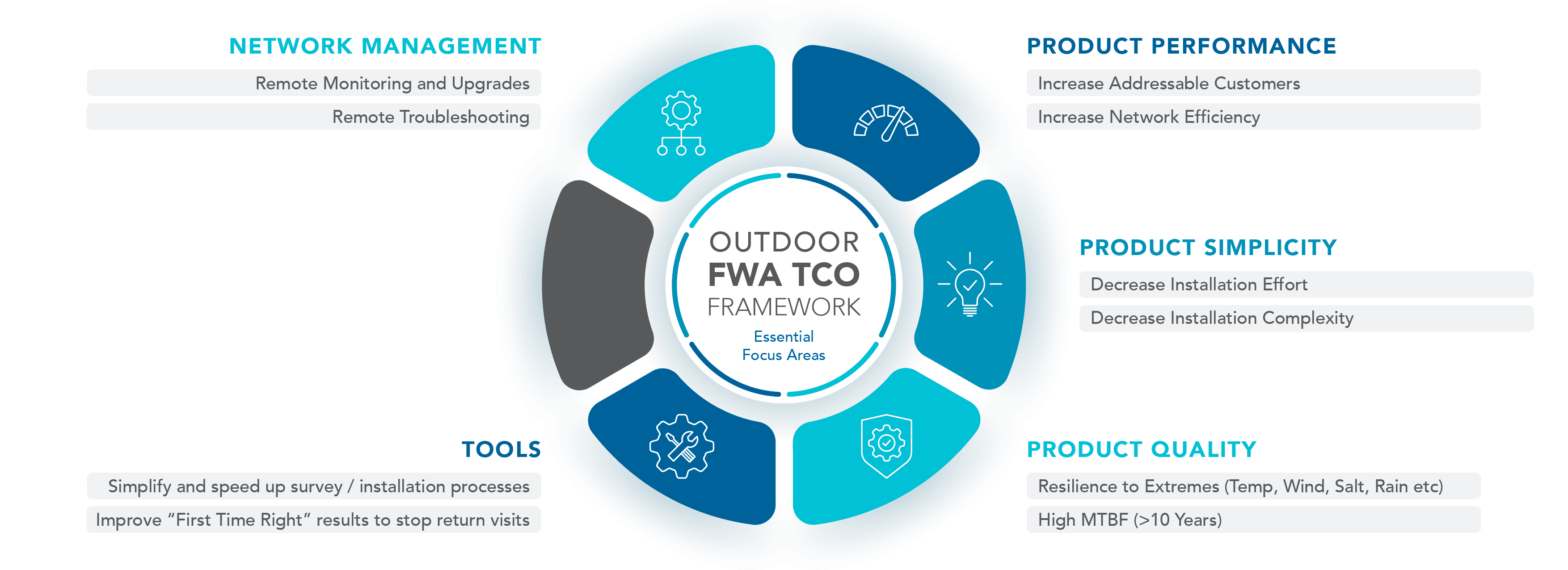 Outdoor FWA TCO Framework
Thanks to lower churn and long device lifespans, carriers with large professionally installed FWA deployments have consistently realised TCO benefits, despite the initial truck roll investment.
From 4G to 5G
With a typical outdoor FWA device lifespan of more than 10 years and very low failure rates (often below 0.3%), carriers generally do not incur incremental truck roll costs for device replacement during normal operation.
Today, NetComm is proud to have outdoor devices (ODUs) still in service after more than 13 years, operating reliably in harsh environments across the globe and continuing to deliver connectivity to satisfied end customers.
That said, there inevitably comes a point where carriers must invest in a new truck roll to replace installed devices. Common triggers include:
- A technology shift (e.g. from 4G to 5G), including the retirement of legacy network technologies
- The introduction of new or replacement frequency bands not supported by existing devices
- Network efficiency improvements that require new device capabilities (e.g. higher MIMO orders or carrier aggregation levels)
With 5G now a mature technology, many networks globally are entering a phase where large-scale replacement of legacy 4G devices is being considered.
Device replacement not only involves an additional truck roll and new device CAPEX, but also the disposal of the existing installed base.
Professionally installed outdoor FWA devices are typically larger than self-installed devices. As they are mounted high on walls or rooftops — out of reach of end users — carriers often invest in higher-performance antenna systems to extend coverage and increase the likelihood of achieving higher modulation rates.
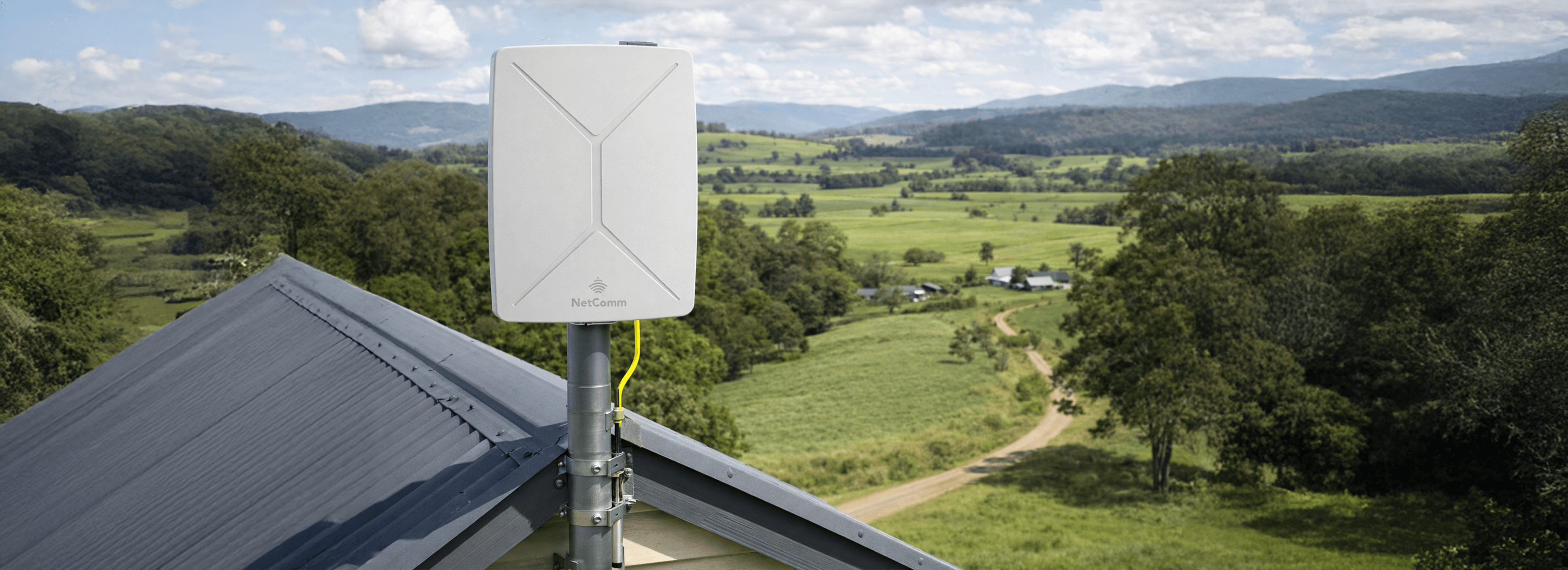 NetComm Ultra High Gain AurusPRO Outdoor CPE
For carriers with hundreds of thousands of deployed devices, a full refresh program can result in the disposal of hardware volumes equivalent to multiple Olympic-sized swimming pools.
While some raw materials can be recovered, this process is costly and inefficient.
NetComm has long prioritised sustainability in product design and packaging, focusing on recyclable and recycled materials and reducing unnecessary plastics. However, as students have learned since the 1970s through the “3 Rs” — Reduce, Reuse, Recycle — focusing solely on reduction and recycling is not enough.
It is time for the FWA industry to place greater emphasis on Reuse.
From 5G to 6G
There has been considerable industry discussion around the path to 6G. From a network infrastructure perspective, the story is relatively clear: aside from the introduction of new spectrum, most upgrades from 5G to 6G are expected to be delivered through software upgrades in the radio access network.
For devices, however, the situation is more complex.
Most 5G devices today rely on chipsets that are tightly coupled to a specific 3GPP release and feature set. To keep device costs low, these chipsets typically have limited ability to support future 3GPP features through software upgrades alone.
This is already evident today, with new 5G device chipsets being introduced every 18–24 months by major chipset vendors in line with new 3GPP releases.
We can expect 6G device chipsets to be commercialised around 2030. At that point, the cycle will repeat, and carriers will once again face the need to refresh their installed 5G device base with 6G-capable hardware.
Preparing Today to Reduce Tomorrow’s Truck Rolls
There is no better time to reduce future truck roll costs and increase reuse than during a truck roll performed today.
What if an outdoor FWA device refresh process:
- Could be completed in 15 minutes or less per building?
- Did not require the end customer to be present?
- Did not require indoor access?
- Did not require additional drilling or new cabling?
- Could be treated like routine maintenance of outdoor fixed network plant, with only a brief outage notice sent in advance?
- Reused the original survey, alignment, and tilt, eliminating the need to repeat these steps?
- Reused as many physical components as possible from the existing installation, minimising waste, future disposal costs and incremental device CAPEX?
Sounds too good to be true? It isn’t.
By adding a new focus area — Device Refresh — to the existing TCO framework, carriers can drive significant long-term cost and sustainability benefits.
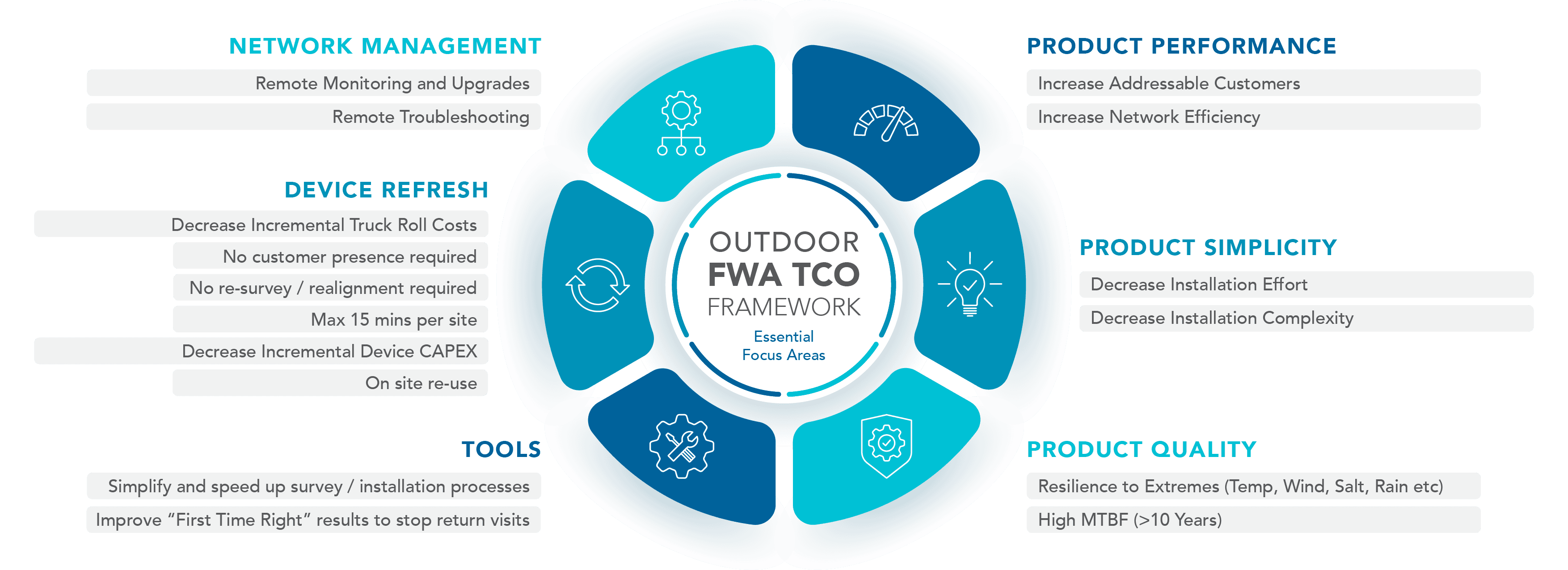 Updated Outdoor FWA TCO Framework
If you would like to learn more about the innovation NetComm is developing in this area, or if you are a carrier seeking to ensure you are asking the right questions of your vendors, please get in touch. We would be happy to share a preview of what’s coming next.
NetComm: Multiple outdoor offerings
NetComm's latest 3GPP-based 5G outdoor FWA devices build on an 18-year history of FWA innovation. NetComm solutions have supported some of the largest and harshest outdoor FWA deployments worldwide. With proven offerings for both self-installation and technician installation, NetComm helps FWA providers navigate the intricacies of selecting the right device for their deployment strategies.
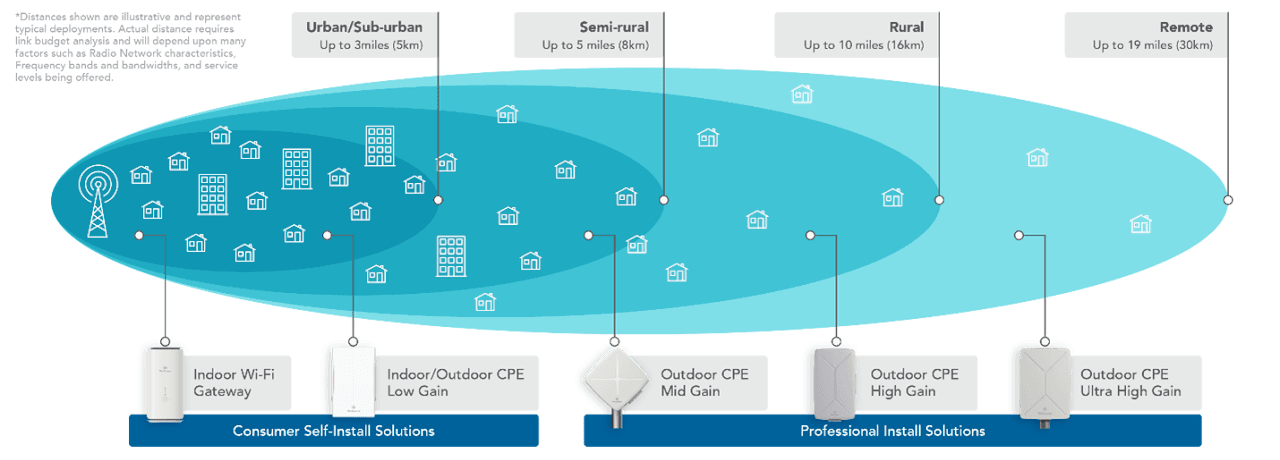
Ready to boost your connectivity? Explore our innovative Fixed Wireless Access solutions, designed for high-performance across urban, suburban, and even remote rural environments.
Let’s connect and transform your network today!
NetComm is a 100% owned subsidiary of Zhone.
To learn more about the NetComm vision of reducing future Truck Roll costs for professional FWA installation, visit NetComm at MWC Barcelona 2026, stand 5F85.